CLASS OF CLASS OF INDIVIDUAL - Business Process
| Synonym | Organizational Process | ||
|---|---|---|---|
| Description |
Abstract Concept
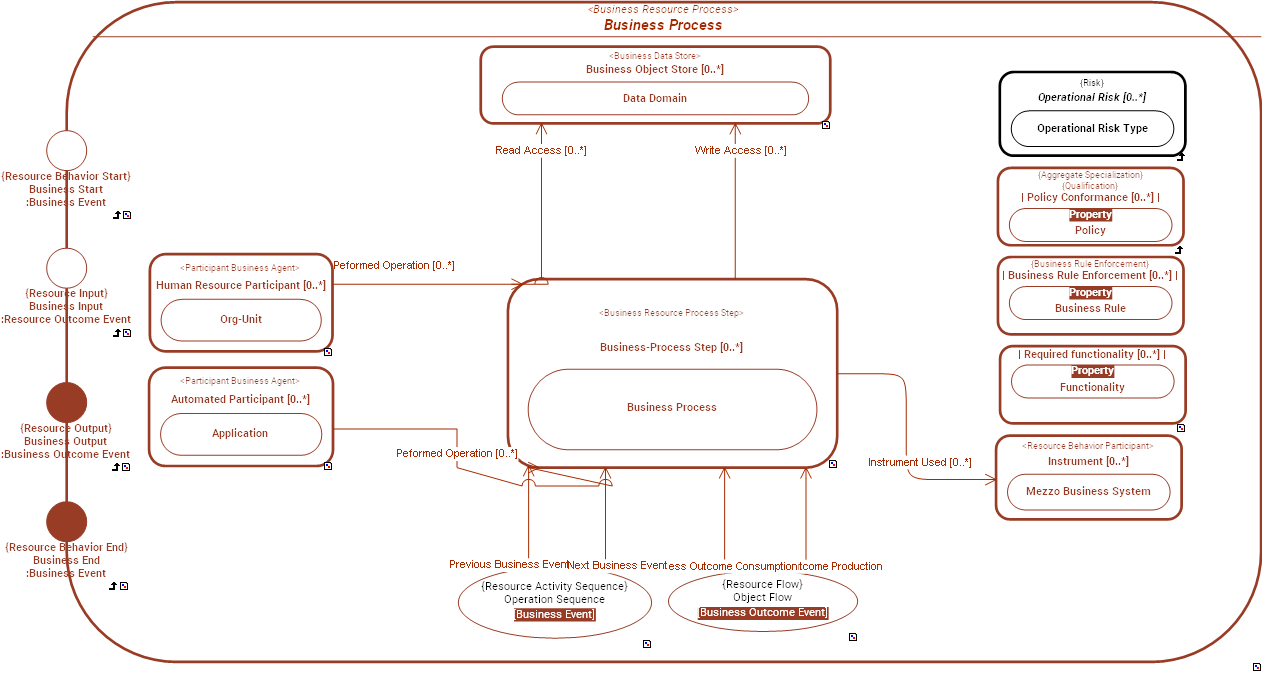
A Business Process is a set of Business-Process Steps performed by Org-Unit Types and/or by automated systems (Business Systems) to produce a Business Outcome Event. It is depicted as a series of Business-Process Steps, controlled by Business Events and conditions. Business-Process Steps are carried out by the involvment of Org-Unit Types and system resources (often Applications) as participants in the process ( Participant Business Agents). During its course of action, a Business Process consumes or produces Business Objects. 1) It may memorize or access Business Objects from its Process Store. 2) It may receive Business Objects at its boundary: Business Outcome Consumption. 3) It may signal the production of Business Objects at its boundary: Business Outcome Production. The course of actions of a Business Process is constrained by the application of rules ( Business Rule Enforcement) that define how to react to what is allowed and not allowed to do,
Systemic Levels of Business Process: a Business Process is either a Business Procedure or an Operations Process
|
||
| External references |
 ISO 9000 - 3.4.1 - Process Lean.org - Value Stream Lean.org - Value Stream Mapping OMG - BMM - Business Process OMG - BPMN - Process OMG - UAF - Function OpenGroup - OAA - Process OpenGroup - TOGAF - Enterprise Metamodel Overview OpenGroup - TOGAF 9 - Definition - Process ISO 9000 - 3.4.1 - Process Lean.org - Value Stream Lean.org - Value Stream Mapping OMG - BMM - Business Process OMG - BPMN - Process OMG - UAF - Function OpenGroup - OAA - Process OpenGroup - TOGAF - Enterprise Metamodel Overview OpenGroup - TOGAF 9 - Definition - Process | ||
| Super Types |  Business Resource Process (from partition: Resource Agent Nature of Business Resource Process) Business Resource Process (from partition: Resource Agent Nature of Business Resource Process) | ||
| Dictionary |  Dictionary of SysFEAT concepts Dictionary of SysFEAT concepts | ||
| Lexical Scope |  Architecture Container
 | ||
| Framework Mapping | BMM Mapping : Business Process UAF - Personal Views : Function UAF - Resource Views : Function SysFEAT Outcome Centric Model : Process TOGAF - Enterprise Metamodel Mapping : Process |
RELATIONSHIPS
Simple Graph Graph & Inheritance Table
Simple Graph
Composition: ➝ Classification: ➝ Specialization: ➝ Instance Of: --> Enumerated definition: ➝ Syntax: ➝
LOGICAL FORMULATION
LOGIC-AGDA RDF
File: 57dfc52d550932ef.agda
SEMANTIC TAXONOMY
Sub-Types Super-Types
SUB-TYPES
Click node rectangle to collapse/expand one level. Click triangle for full recursive collapse/expand. Double-click on a node to open its URL. Hover for description.
BORDERS
| Name | Super type | Border Type | Description |
|---|---|---|---|
| Business End |  Resource Behavior::Resource Behavior End Resource Behavior::Resource Behavior End |  Business Event Business Event | A Business End is a temporal border of a Resource Behavior that refers to the end of the Resource Behavior through the production of a Business Event. |
| Business Input |  Resource Behavior::Resource Input Resource Behavior::Resource Input | Resource Outcome Event | A Business Input is a border of a Resource Behavior that refers to the consumption of an Business Outcome Event that starts the Resource Behavior. |
| Business Output | Resource Behavior::Resource Output |
Business Outcome Event | A Business Output is a border of a Resource Behavior that refers to the production of a Business Outcome Event that ends the Resource Behavior. |
| Business Start | Resource Behavior::Resource Behavior Start | Business Event | A Business Start is a temporal border of a Resource Behavior that refers to the start of the Resource Behavior triggered by consumption of a Business Event. |
INTERNAL STRUCTURE
CONNECTORS
| Connector | Source | Target | Connector Type | Description |
|---|---|---|---|---|
 Object Flow Object Flow |
 Business-Process Step. Business Output Business-Process Step. Business Output |
Business-Process Step |
Business Outcome Event |
Information flow between process activities. |
| Operation Sequence |
Business-Process Step. Business End |
Business-Process Step. Business Start |
Business Event |
An Operation Sequence is used to show the order in which steps of a process will be performed. Each Operation Sequence has only one source and only one target. |